Save hours every week
Turn your bank statements (PDF) into Excel, CSV or OFX, without manual retyping.
A small-business bank statement can answer cash questions—when money settled, which counterparties recur, and how balances changed—but it is not a profit-and-loss statement or a complete view of the business. It misses unpaid invoices and bills, non-cash items, processor gross-up and transactions outside the account. This guide builds a monthly cash-movement analysis and explains when to reconcile it to the books.

What Bank Statement Analysis Reveals
Most entrepreneurs check their bank balance and move on. That single number — your current balance — tells you almost nothing about the financial health of your business. It is a snapshot with no context. Bank statement analysis gives you the context.
When you systematically review your transaction history, patterns emerge that are invisible in day-to-day operations. You start to see when cash actually arrives versus when invoices are sent. You notice that certain months consistently drain your reserves. You spot subscriptions you forgot existed and vendor charges that quietly increased.
Here is what a structured analysis can uncover across different dimensions of your business:
| Analysis Type | What It Reveals | Business Impact |
|---|---|---|
| Cash flow timing | When money actually arrives and leaves | Prevents cash crunches before they happen |
| Spending patterns | Where money goes by category and vendor | Identifies cost-cutting opportunities |
| Revenue trends | Seasonal peaks, client concentration, growth rate | Informs sales strategy and forecasting |
| Hidden fees | Bank charges, payment processing costs, penalty fees | Recovers money lost to overlooked expenses |
| Recurring charges | Subscriptions, retainers, automatic payments | Eliminates waste from unused services |
| Client behavior | Payment timing, consistency, average transaction size | Improves invoicing and collection practices |
The statement is authoritative for what the bank posted to that account, not for accounting classification or business purpose. A discrepancy may come from timing, an incorrect book entry, a bank issue or an extraction error, so investigate rather than declaring either side automatically correct.
Cash Flow Timing Is Everything
For small businesses, profitability and solvency are two different things. You can be profitable on paper and still run out of cash. Bank statement analysis reveals the timing gap between earning revenue and receiving payment. If your clients consistently pay 45 days after invoicing, but your rent, payroll, and suppliers draw from your account every 30 days, you have a structural cash flow problem that no amount of revenue growth will solve on its own.
Spending Patterns Tell the Truth
When asked where their money goes, most business owners can name their top three or four expenses. Bank statement analysis reveals the other 30 or 40 line items that collectively may account for a significant portion of total spending. Software subscriptions, office supplies, fuel costs, professional services — the small recurring charges that individually seem negligible often add up to a surprising total.
Step-by-Step Bank Statement Analysis
Analyzing your bank statements does not require an accounting degree. It requires discipline, a spreadsheet, and a willingness to look at your financial reality without flinching. Here is a practical walkthrough.
Step 1: Gather Your Statements
Choose a period long enough for the decision: several months for cash timing, and at least a comparable seasonal period when seasonality matters. Collect every account in scope and avoid double counting transfers.
If your statements are in PDF format, you will need to extract the transaction data into a spreadsheet before you can work with it. Manually copying hundreds of transactions is tedious and error-prone — this is where a purpose-built extraction tool saves significant time.
Step 2: Categorize Every Transaction
Create a consistent set of categories that match how your business actually spends and earns money. Avoid making your categories too broad (“Operating Expenses” tells you nothing useful) or too narrow (you do not need a separate category for every vendor).
A practical category framework for most small businesses includes:
- Customer receipts: Client payments and banked sales; identify net processor payouts separately
- Refunds and reversals: Link to the original payment rather than automatically treating them as sales
- Transfers and financing: Own-account transfers, card repayments, loan proceeds/principal and owner contributions/drawings
- Payroll: Salaries, contractor payments, tax withholdings
- Rent and Utilities: Office space, electricity, internet, phone
- Software and Tools: SaaS subscriptions, cloud services, licenses
- Marketing: Advertising, events, sponsorships, content
- Professional Services: Legal, accounting, consulting fees
- Travel and Meals: Transportation, accommodation, client entertainment
- Bank and Payment Fees: Service charges, transaction fees, interest
- Insurance: Business, health, liability premiums
- Needs review: Items whose purpose is not yet supported; investigate material amounts rather than relying on an arbitrary percentage
Go through every transaction and assign a category. Yes, every one. The transactions you skip are often the ones hiding the most useful insights.
Step 3: Calculate Your Core Metrics
Once categorized, calculate the metrics that matter most for your business (detailed in the next section). At minimum, compute your monthly cash inflows, cash outflows, and net cash flow for each month in your analysis period.
Step 4: Identify Patterns and Anomalies
With your data categorized and metrics calculated, look for:
- Seasonal patterns: Do certain months consistently show higher revenue or higher expenses?
- Growth or decline trends: Is your monthly revenue trending upward, flat, or downward over time?
- Expense creep: Are any categories growing faster than revenue?
- Concentration risk: How much of your validated customer receipts comes from the largest clients? Choose a risk threshold appropriate to your business.
- Timing mismatches: Are there predictable periods where outflows exceed inflows?
Write down what you find. These patterns become the basis for better financial decisions.
Step 5: Take Action
Analysis without action is just arithmetic. Based on what your statements reveal, identify the top three changes that would most improve your financial position. Maybe it is renegotiating a vendor contract, adjusting your payment terms, cutting unused subscriptions, or building a cash reserve for a predictable slow season.
Key Metrics to Track
Not every number matters equally. These metrics create a useful cash view after the statement rows and classifications have been validated; they do not replace the ledger or financial statements.
| Metric | Formula | What It Tells You |
|---|---|---|
| Cash inflow/outflow ratio | Cash inflows / cash outflows | Direction of cash movement; not profitability |
| Gross cash outflow | Total outflows by month | Operating cash demand, including items requiring reclassification |
| Indicative cash cover | Available cash / chosen recurring cash-cost measure | Scenario metric; define the denominator explicitly |
| Deposit trend | Comparable-period deposits | Banked receipts, not necessarily revenue |
| Cash cost mix | Category outflows / relevant outflows | Which paid-cost categories drive cash use |
| Average or minimum balance | Daily balances where available | Liquidity timing within the period |
| Counterparty concentration | Largest identified customer deposits / total identified customer deposits | Approximate cash-receipt dependency after validation |
| Fee share | Identified bank/processor fees / relevant receipts | Paid transaction costs after gross-up review |
How to Use These Metrics
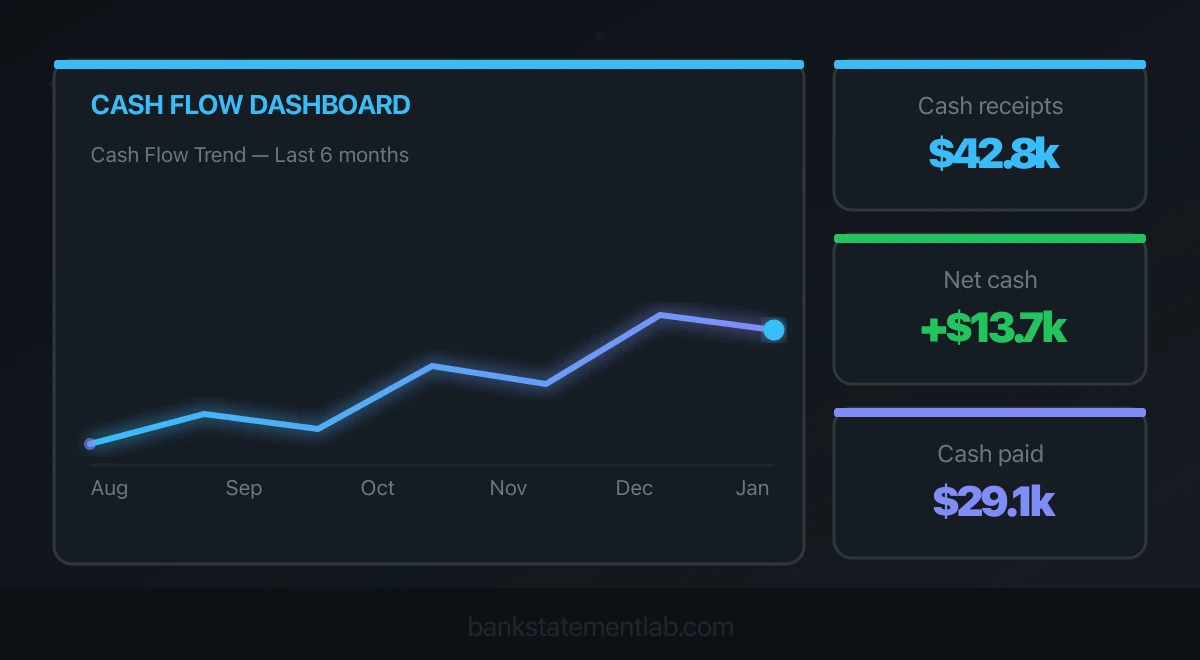
Do not just calculate these numbers once. Track them monthly. Create a simple dashboard in your spreadsheet with one row per month and one column per metric. After three to four months, the trends become far more valuable than any single data point.
Use trends as questions, not universal thresholds. A large tax payment, equipment purchase, loan draw or processor payout can distort a month. Reconcile unusual changes to the ledger, invoices and forecast before acting.
Create the cash-analysis table. BankStatementLab extracts statement rows to Excel, CSV or JSON. Validate every table against the original pages and flag both legs of internal transfers. Exclude those transfers from consolidated operating totals while retaining them for each account’s reconciliation. Try it →
Common Bank Statement Analysis Mistakes
Even diligent business owners fall into traps that undermine the quality of their analysis. Avoid these pitfalls to make sure your conclusions are sound.
Mistake 1: Ignoring Seasonality
Looking at a single month and drawing conclusions is one of the most common errors. A bad month might just be your industry’s slow season. A great month might be an anomaly driven by one large client payment that arrived early. Always compare months to the same period in the prior year, not just to the previous month. If you do not have a full year of data yet, at least flag potential seasonal effects rather than treating every fluctuation as a trend.
Mistake 2: Mixing Personal and Business Transactions
If your business account contains personal transactions — or if you occasionally pay business expenses from a personal account — your analysis will be distorted. Every personal coffee purchase inflates your business expense totals. Every business payment from a personal card makes your business look less costly than it actually is. Separate your accounts completely. If that ship has already sailed, tag personal transactions during categorization and exclude them from business metrics.
Mistake 3: Using Too Short a Time Horizon
Three months of data can show you a snapshot. Twelve months show you a cycle. Two or more years show you real trends. Many business owners analyze only their most recent quarter because it is convenient. But short time horizons miss seasonal patterns, mask gradual cost increases, and can lead to overreactions to normal fluctuations. The longer your analysis period, the more reliable your conclusions.
Mistake 4: Overlooking Small Recurring Charges
A $15 software subscription does not seem worth investigating. But if you have 20 of them, that is $300 per month or $3,600 per year. Small recurring charges are easy to forget about because they fly under the radar of attention individually. During your analysis, create a dedicated list of every recurring charge, no matter how small. Review each one: is this tool still being used? Is there a cheaper alternative? Could two tools be consolidated into one?
Mistake 5: Analyzing Without a Comparison Baseline
Numbers without context are meaningless. Knowing that you spent $4,200 on marketing last month tells you nothing unless you know what you spent the previous month, the same month last year, and what percentage of revenue that represents. Always analyze metrics as ratios, trends, or comparisons — never as isolated figures.
Building a Monthly Analysis Routine
The most valuable bank statement analysis is the one that happens consistently. Here is a practical routine you can follow every month, adapted to your number of accounts, transactions and unresolved exceptions.
Week 1 of Each Month: Data Collection
- Download the previous month’s bank statement from every business account
- Extract transaction data into your analysis spreadsheet
- If using PDFs, run them through an extraction tool to get clean, structured data
Week 1 of Each Month: Categorization and Metrics
- Categorize all new transactions using your established category framework
- Update your monthly metrics dashboard with the latest numbers
- Flag any transactions you do not recognize for investigation
Week 1 of Each Month: Pattern Review
- Compare this month’s metrics to the prior month and the same month last year
- Investigate material changes by both amount and percentage; agree review thresholds for your business
- Check your cash flow ratio and runway metrics for warning signs
- Review your list of recurring charges for any new additions
Monthly Action Items
Based on your review, identify one to three specific actions:
- If cash flow ratio dropped: Investigate which category drove the change. Delay discretionary spending if needed.
- If a new recurring charge appeared: Confirm it is authorized and necessary.
- If revenue concentration increased: Prioritize sales efforts to diversify your client base.
- If fees increased: Contact your bank or payment processor to negotiate or switch providers.
Quarterly Deep Dive
Every three months, do a more thorough analysis:
- Review all vendor relationships and renegotiate contracts where possible
- Compare year-over-year metrics to identify true trends versus noise
- Update the forecast with actual settled amounts, unpaid invoices and bills, and revised assumptions
- Share key findings with your accountant or financial advisor
This routine creates a repeatable cash-control view. Use it alongside accounts receivable, accounts payable, payroll, tax and forecast data for hiring, investment or financing decisions.
Compare bank movements with your books
Before using the cash analysis for a management decision, compare its source statements with the bank-account entries in your books. BankStatementLab’s bank reconciliation report proposes pairs to approve and keeps one-sided entries visible in Excel, CSV or PDF. Investigate those exceptions before interpreting a change in cash as operating performance.
Conclusion
Bank statement analysis for small business is not about becoming a financial analyst. It is about developing a clear, data-driven understanding of how money moves through your company. The entrepreneurs who thrive long-term are the ones who know their numbers — not from memory, not from gut feeling, but from systematic, honest review of actual transactions.
Start with the basics: gather your statements, categorize your transactions, and calculate the core metrics outlined in this guide. Build a monthly routine. Look for patterns over time rather than reacting to individual months. Avoid the common mistakes that distort analysis, and always measure your numbers against meaningful baselines.
The data is already there, sitting in your bank account history. The only question is whether you are going to use it.
Ready to build a structured working dataset? BankStatementLab extracts transactions from supported statement PDFs into Excel, CSV or JSON. Check the result against the source before using it. Start your analysis →
Related Articles
Save hours every week
Turn your bank statements (PDF) into Excel, CSV or OFX, without manual retyping.