Try with your file
Drop your PDF
1 file · 100 pages max · Free preview of 2 pages
1 file selected
Save hours every week
Turn your PDFs into Excel, CSV, or OFX, with no manual data entry.
Drop a PDF statement and watch the extraction happen live. Instant preview, no signup required.
Yes: ChatGPT can turn transactions it reads from a bank-statement PDF into a table that you can download as CSV and open in Excel. It is not, however, a guaranteed bank-statement parser. OpenAI’s current data-analysis guidance explicitly recommends a spreadsheet or text-based file when exact values matter. That warning matters here: one dropped row or reversed sign can make a bank import or reconciliation wrong.
Use ChatGPT for a one-off extraction only when you are prepared to compare the result with the original. Prefer the bank’s own CSV or OFX export when it exists. For a scanned, long, multi-currency or recurring workload, use a document-specific workflow and apply the same validation checks.
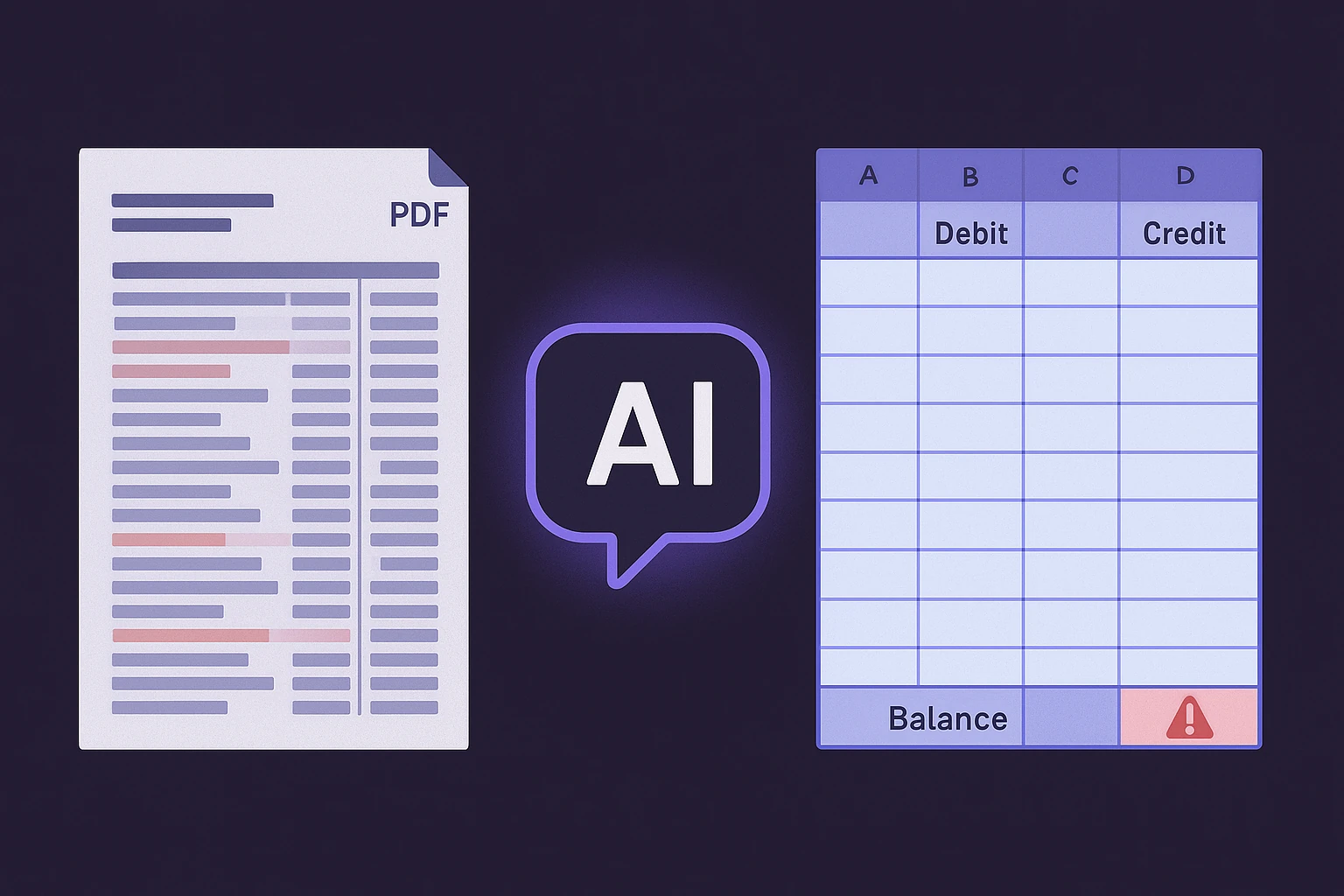
What ChatGPT can read from a bank-statement PDF
The answer depends on the plan and on how the PDF was created. OpenAI’s current File Uploads FAQ says that non-Enterprise document retrieval extracts digital text and discards images embedded in PDFs. A scanned statement is made of page images, so that text-only route has no transaction text to extract. OpenAI documents visual PDF retrieval for ChatGPT Enterprise, where both text and visual elements can be interpreted.
This distinction is more useful than a page-count rule:
| Processing path | What it can read | What it cannot do |
|---|---|---|
| Digital, selectable text | Text retrieval can read characters, but row and column relationships may still be misinterpreted | Wrapped descriptions, separate debit/credit columns, subtotals |
| Scanned PDF on a text-only plan | There may be no usable transaction text | Use a bank export, OCR first, or a supported visual-document workflow |
| PDF processed with visual retrieval | The model can interpret page layout and images | Exact digits and complete row coverage still require verification |
File availability and limits change by model, plan and workspace setting. Check the official upload page before using the workflow rather than relying on a fixed limit copied from an older guide.
A safer ChatGPT-to-Excel workflow
- Check the source first. If your bank offers CSV, OFX or QIF for the period, download that instead of asking any AI to reconstruct rows from a PDF.
- Test whether the PDF has selectable text. If not, confirm that your ChatGPT plan supports visual PDF retrieval; otherwise do not expect the scan to be read.
- Remove sensitive pages and fields you do not need. Do not upload another person’s statement unless you have authority and an appropriate data-processing basis.
- Ask for a strict schema. Request one row per transaction with
date,description,debit,credit,currencyandrunning_balance, and tell ChatGPT not to infer unreadable values. - Ask for CSV, not prose. OpenAI documents downloadable CSV tables in ChatGPT data analysis.
- Verify before import. Keep the original PDF open beside the exported table and run the checks below.
A useful prompt is:
Extract only transaction rows from this statement. Return a downloadable CSV with date, full description, debit, credit, currency and running balance. Preserve the source date text in a separate column. Do not infer an unreadable value: leave it blank and add
needs_review = true. Exclude headers, opening balances, carried-forward lines and subtotals.
Seven failure modes to check
These failure modes can occur with any PDF extraction workflow. Chat output can look orderly even when the source-to-row mapping is incomplete.
| Failure mode | What you get | Why it happens |
|---|---|---|
| Scanned or photographed statement | Plausible rows with wrong digits, or an empty result | No text layer, so every figure is read from pixels; compression makes small type ambiguous |
| Long, dense statement | A table that stops early, repeats a page, or omits rows between repeated headers | Page segmentation, repeated headers, upload limits and table reconstruction can break the one-source-row-to-one-output-row mapping |
| Debit and credit merged into one column, or negatives in parentheses | Every amount positive; totals inflated; balance check fails | The sign lives in the layout or in typography (parentheses, trailing minus, red ink), not in the digits |
| Ambiguous dates such as 03/04 | Dates reinterpreted; transactions land in the wrong month | Day-first versus month-first is a property of the issuing bank, invisible in the digits; only days up to 12 are ambiguous, so errors scatter |
| Running balance lines, subtotals, carried-forward rows | Extra transactions; totals double-counted | A balance brought forward has a date and an amount, so it looks like a transaction |
| Descriptions spread over two or three lines | Two transactions merged into one, or one split into two with a zero amount | Row boundaries are inferred from vertical spacing, and wrapped merchant names break that inference |
| Multi-currency statement | One amount column mixing units, conversions invented or dropped | Currency is a per-row attribute in the source but a per-column assumption in the export |
Parenthesised negatives deserve special attention: a withdrawal printed as (1,234.56) can become a positive number or remain text that SUM ignores. Also check page boundaries, because repeated headers and “balance carried forward” lines can be mistaken for transactions.
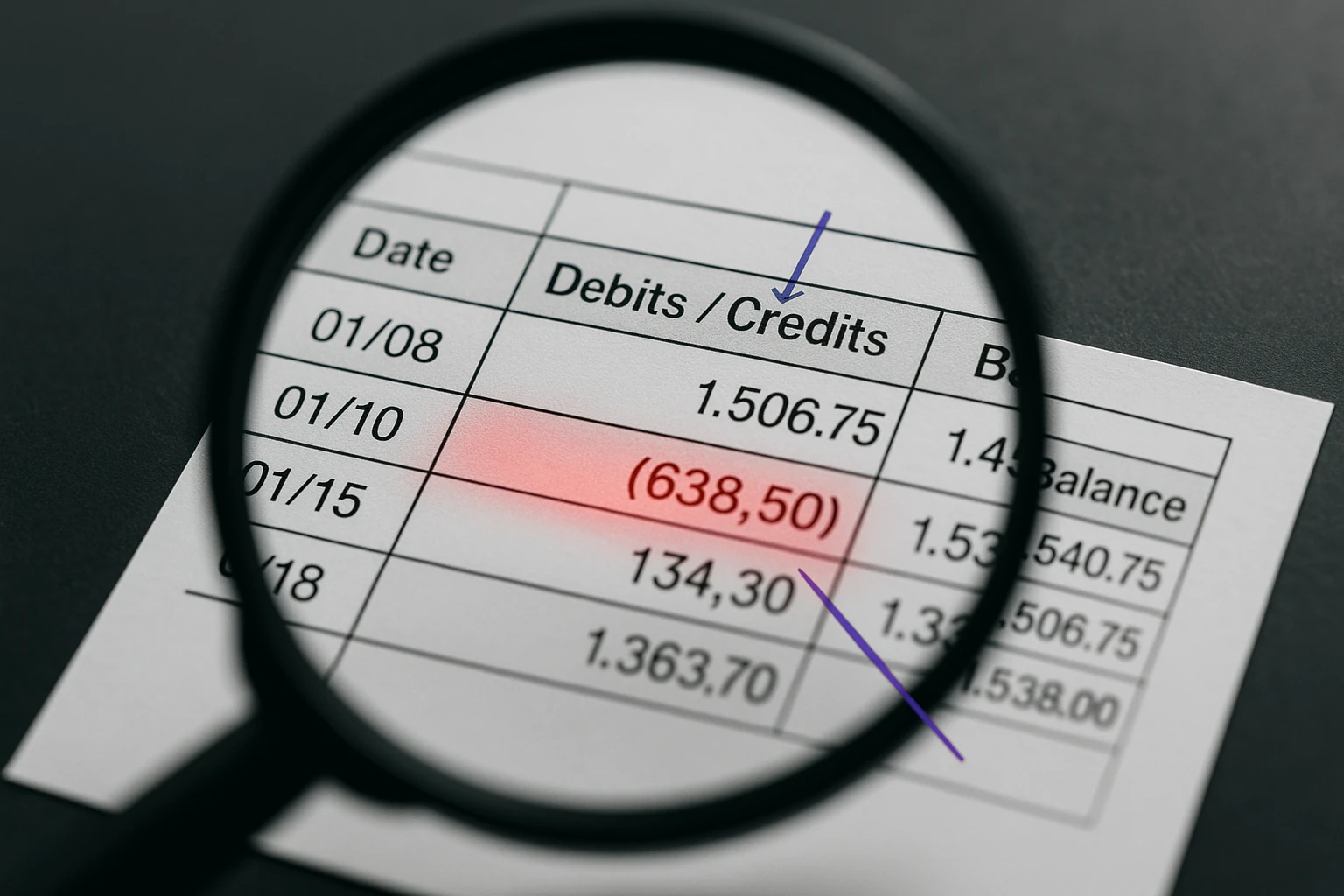
Why a correct total does not prove a correct extraction
For data-analysis tasks, ChatGPT can run Python over the extracted table. That makes the arithmetic reproducible, but it does not validate the inputs against the PDF. A misread amount can be summed perfectly. Only a comparison with values printed on the original statement tests the extraction.
How to verify the extracted spreadsheet
Assume headers in row 1 and data from row 2 to row 400, with dates in A, descriptions in B, debits in C and credits in D. Adjust the ranges and separators for your workbook.
-
Type the reference numbers from the PDF first. Put the opening balance in cell H1 and the closing balance in H2, read off the statement, never copied from the AI output, and count the transaction lines page by page.
-
Run the balance check where the statement supports it. For a single-currency statement whose opening and closing balances cover all posted rows, enter
=ROUND(SUM(D2:D400)-SUM(C2:C400)-(H2-H1),2); with a single signed column, use=ROUND(SUM(E2:E400)-(H2-H1),2). Match the statement’s own sign convention and rounding. A non-zero result is an exception to investigate; a zero result is useful evidence but can hide offsetting errors. -
Count the rows two ways. Enter
=COUNT(A2:A400)and=COUNTA(B2:B400): COUNTA gives populated description rows, COUNT gives rows holding a real Excel date, and a gap between them means dates came back as text. If either differs from your PDF line count, rows were dropped or invented. -
Verify the first and the last transaction. Compare row 2 and the final populated row with the PDF: date, description, amount, sign. The first row catches headers swallowed as transactions, the last catches truncation.
-
Spot-check three ambiguous dates. Enter
=SUMPRODUCT((A2:A400<>"")*(DAY(A2:A400)<=12))to count rows where day and month could have been swapped without producing an impossible date, then check three of them against the PDF. The formula needs real Excel dates, so run step 3 first. Confirm the range with=MIN(A2:A400)and=MAX(A2:A400). -
Compare the totals with the printed ones. Enter
=SUM(C2:C400)and=SUM(D2:D400)and compare with the total debits and credits printed on the statement. This catches errors that cancelled out in step 2. -
Hunt duplicates and text amounts. Use a duplicate highlight on date + description + debit + credit, and check
=SUMPRODUCT(--ISTEXT(C2:C400))+SUMPRODUCT(--ISTEXT(D2:D400)). Inspect zero amounts rather than assuming they are always invalid.
A balance check that returns 0 is strong evidence, not proof—two offsetting errors can cancel out, which is why steps 3 to 7 exist. A non-zero result can reflect an extraction problem, the wrong sign convention, omitted statement sections or a statement-specific adjustment; resolve it before relying on the table.
Privacy before upload: check your ChatGPT plan and settings
A statement can expose account identifiers, balances, salary, creditors and spending patterns. Uploading it is a data-handling decision before it is a spreadsheet task.
| ChatGPT context | Current OpenAI documentation |
|---|---|
| Personal workspace (entry tier, Plus or Pro) | Data sharing for model improvement is on by default; turn off Improve the model for everyone before a new upload if that is your choice |
| Temporary Chat | Not used for training; automatically deleted from OpenAI systems within 30 days |
| Business, Enterprise, Edu and API | Inputs and outputs are not used for training by default |
| Files saved to Library | Managed separately from chats; deleting a chat does not delete a Library file |
These rules come from OpenAI’s current training-control instructions, Data Controls FAQ and file-retention documentation. Policies and product behaviour can change, so re-check them before handling client material. Turning training off affects model improvement; it does not make the upload local or erase it automatically.
If the statement belongs to a client, confirm that you have authority to use the service and that its terms, retention and subprocessors fit your professional obligations. Removing an account number does not anonymise a statement that still contains names, employers and payment narratives.
When a purpose-built converter makes more sense
A dedicated workflow is useful when you have multiple files, scans or repeated monthly work. BankStatementLab accepts unlocked PDF, JPEG, PNG and WebP files and exports CSV, XLSX or JSON. Authenticated uploads allow up to 100 files and 100 pages in total, with a 50 MB limit per file. Standard extraction uses one credit per page and advanced extraction uses two. New accounts include five credits.
| Workflow question | General ChatGPT upload | BankStatementLab |
|---|---|---|
| Output | A generated table or CSV, depending on the tool used | CSV, XLSX or JSON export |
| Multiple statements | Depends on plan and upload caps | Batch upload and merged or separate exports |
| Locked PDF | Plan-dependent handling | Rejected; unlock locally first |
| Source-file retention | Depends on ChatGPT mode, Library and workspace policy | Deleted after a successful extraction; failed jobs can remain for troubleshooting for up to 14 days |
| Extracted-data retention | Chat/file policy for the selected workspace | User-controlled deletion; authenticated auto-deletion can be set from 1 to 30 days, with 14 days as the configured default when enabled |
A document-specific pipeline is not infallible. A blurred photo, an unusual multi-currency layout or a poor scan still needs human review. The advantage is a repeatable export and batch workflow, not a promise of perfect accuracy. Convert a statement and run the checks yourself.
Key takeaways
- ChatGPT can generate a downloadable transaction table, but OpenAI recommends structured or text-based input when exact values matter.
- Non-Enterprise PDF retrieval is currently text-only according to OpenAI; scanned PDFs require a visual-document path.
- Missing rows, flipped signs, ambiguous dates and carried-forward balances are the checks that matter most.
- Where the statement’s structure supports it, credits minus debits should explain the movement from opening to closing balance; investigate any difference and still check for offsetting errors.
- A total computed by ChatGPT proves nothing, because it runs on values the model read first; compare against a figure printed on the original statement.
- In personal ChatGPT workspaces, turn off model-improvement sharing before a new upload if desired; Business, Enterprise, Edu and API data are excluded from training by default.
Frequently Asked Questions
Can ChatGPT convert a bank statement PDF to Excel?
Yes. ChatGPT can extract a table and let you download it as CSV, which Excel can open. Treat it as a draft: compare it with the PDF, reconcile totals and inspect dates and signs before importing or reporting from it.
Can ChatGPT read a scanned bank statement?
Only if the selected ChatGPT plan and upload flow processes PDF visuals. OpenAI currently documents visual PDF retrieval for Enterprise; other document-upload plans use text retrieval and discard embedded images. A scanned PDF has no digital transaction text, so verify plan support first.
Why does ChatGPT miss transactions in the middle of a long statement?
Long, dense tables are harder to segment consistently, especially across page breaks and repeated headers. Do not infer completeness from the first and last rows. Count the transactions and reconcile the statement totals.
How do I check whether an AI extraction of my bank statement is correct?
For a single-currency statement whose balances cover all posted rows, compare credits minus debits with the movement from opening to closing balance. In Excel, use =ROUND(SUM(D2:D400)-SUM(C2:C400)-(H2-H1),2) after matching the source sign convention. Investigate any difference, then count rows, verify page boundaries and spot-check ambiguous dates.
Does ChatGPT get amounts wrong even when the total looks right?
Yes. ChatGPT can write and run Python, so the arithmetic step is deterministic, but it operates on the values the model read from the page first. Misread amounts summed perfectly give a wrong total that is internally consistent. Only a comparison with a number printed on the original statement is meaningful.
Is it safe to upload a bank statement to ChatGPT?
It depends on your plan, settings and authority to upload the data. Personal-workspace content can be used to improve models unless you turn that setting off; Business, Enterprise, Edu and API inputs are excluded by default. Review file retention separately, especially Library files.
What is the difference between ChatGPT and a dedicated bank statement converter?
A dedicated converter provides a repeatable transaction schema, batch workflow and CSV/XLSX/JSON exports. ChatGPT is a general analysis assistant whose PDF behaviour varies by plan. Neither removes the need to reconcile the extracted rows with the original statement.
Is BankStatementLab more accurate than ChatGPT for bank statements?
There is no published head-to-head measurement, so an accuracy superiority claim would be unsupported. Compare the workflows and validate the result from either tool against the PDF.
Does BankStatementLab keep my bank statement PDF?
After a successful extraction, the source file is deleted. Failed extraction files can be retained for troubleshooting for up to 14 days. Signed-in extracted data remains until you delete it manually unless you enable optional automatic deletion. Automatic deletion is disabled by default; when enabled, it can be set from 1 to 30 days and starts at 14 days.
Save hours every week
Go from PDF to an Excel file ready to use, with no manual data entry.