Try with your file
Drop your PDF
1 file · 100 pages max · Free preview of 2 pages
1 file selected
Save hours every week
Turn your PDFs into Excel, CSV, or OFX, with no manual data entry.
Drop a PDF statement and watch the extraction happen live. Instant preview, no signup required.
Bank statements can help self-employed people find possible business expenses that were never categorized, especially recurring software, payment-processing fees and mixed-use services. They do not determine deductibility on their own. Under the IRS standard, a business expense generally must be ordinary and necessary, and proof that money left an account does not by itself establish business purpose. Use this guide as a review checklist, recover the invoice or receipt behind each candidate, and confirm the treatment for the tax year at issue.

The Deductions Hiding in Your Bank Statements
Start with recurring or clearly business-facing merchants, then investigate rather than automatically claiming them.
| Candidate category | Statement clue | Evidence or calculation still needed |
|---|---|---|
| Home office | Rent, mortgage interest, utilities | Qualifying use of the space and the chosen IRS method |
| Internet and phone | Telecom provider | Reasonable, documented business-use allocation |
| Vehicle | Fuel, tolls, parking | Contemporaneous mileage records and a permitted method |
| Software and services | SaaS, hosting, professional firms | Invoice and business purpose |
| Payment and bank fees | Processor netting, service charge | Processor report or bank fee detail |
| Training and publications | Course, conference, book | Connection to the existing trade or business |
| Equipment | Electronics or office supplier | Receipt, business-use allocation and capitalization treatment |
| Meals and travel | Restaurant, hotel, transport | Who, where and business purpose; applicable limitations |
The IRS small-business recordkeeping guidance is the baseline: keep documents showing the amount and business nature of the expense. Tax savings depend on eligibility, taxable income and applicable federal and state rules, so a flat savings estimate is misleading.
Home Office: The Most Underleveraged Deduction
If you use a qualifying area of your home regularly and exclusively for business, you may be eligible for a home-office deduction. The rules include exceptions and a principal-place-of-business test; review the current IRS Publication 587 before choosing the simplified or actual-expense method.
On your bank statements, this means looking at recurring payments for:
- Rent or mortgage interest
- Electricity, gas, and water
- Homeowner’s or renter’s insurance
- Home maintenance and repairs
The statement helps locate possible costs, but it does not prove exclusive use or calculate the allowable share.
Internet, Phone, and Utilities: The Partial Deductions
Mixed-use phone and internet costs require a reasonable business allocation supported by records. A dedicated business line may be easier to substantiate, but the transaction label alone is not enough.
Vehicle and Mileage: The Biggest Missed Deduction
Vehicle deductions depend on business miles, vehicle history and the method selected. Rates can change—even within a calendar year—so use the IRS mileage-rate table for the relevant dates. Fuel charges can prompt a review, but they do not replace a timely mileage log.
Software, Subscriptions, and Digital Tools
A software subscription may qualify when it is ordinary and necessary for the business. Review mixed-purpose tools and reversed charges rather than assuming every recurring charge belongs on Schedule C. Examples include:
- Project management tools
- Accounting and invoicing software
- Cloud storage services
- Design, development, and writing tools
- Communication platforms
- Website hosting and domain registration
These recurring charges are easy to miss, so group them by vendor and connect each one to an invoice and business purpose.
Health Insurance Premiums: The Above-the-Line Deduction
Some self-employed taxpayers may qualify for a separate health-insurance deduction, subject to eligibility and income limitations. It is not automatically a Schedule C expense. Use the current Form 1040 instructions or a tax professional; the bank debit only identifies a premium to investigate.
QBI is a return calculation, not a bank-statement transaction
Eligible taxpayers may qualify for a qualified business income deduction, subject to multiple limits. It is calculated from tax-return data, not discovered as a debit on a statement. Use the current IRS QBI guidance and do not estimate it by applying a percentage to bank deposits.
Build a transaction review sheet. BankStatementLab extracts statement rows to Excel, CSV or JSON; you then validate, categorize and attach evidence. Try it →
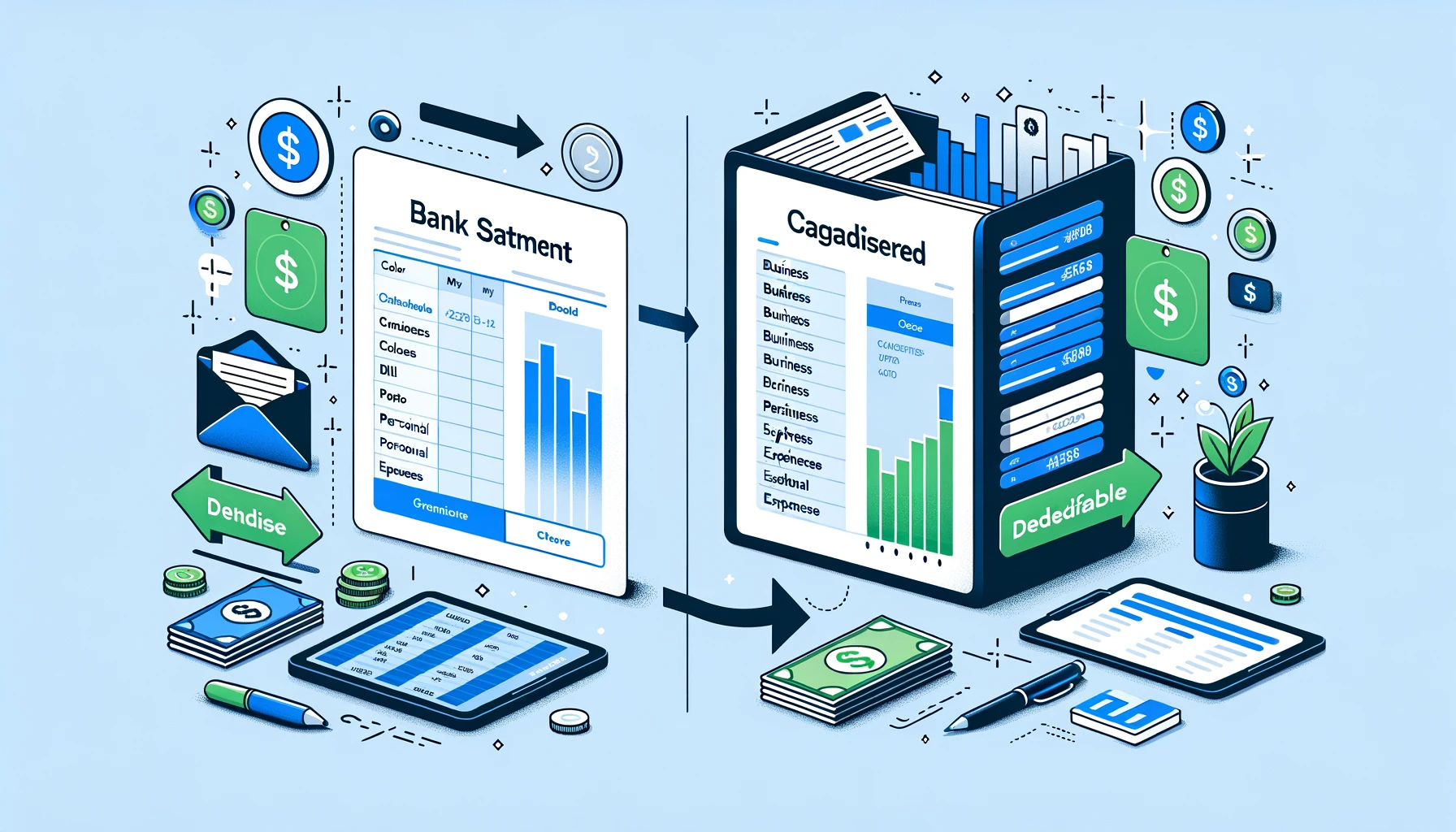
How to Audit Your Bank Statements for Missed Deductions
Knowing which deductions exist is one thing. Systematically finding them in your transaction history is another. Here is a practical, step-by-step method you can use right now.
Step 1: Export or Convert Your Statements
Start by getting your bank statements into a format you can actually work with. If your bank provides CSV or Excel exports, use those. If you only have PDF statements, you will need to convert them into a structured spreadsheet format first. This is where tools that auto categorize bank transactions become essential. Manually scanning through PDF statements line by line is slow, error-prone, and almost guaranteed to cause you to miss something.
Step 2: Separate Personal and Business Transactions
Before you can identify deductions, you need to separate personal and business expenses. If you use a single account for both, go through every transaction and flag it as personal or business. This is the most time-consuming step, but it is non-negotiable.
Step 3: Categorize Every Business Transaction
Assign each business transaction to a Schedule C category. The IRS uses specific line items on Schedule C, including:
- Line 8 — Advertising
- Line 10 — Car and truck expenses
- Line 11 — Commissions and fees
- Line 17 — Legal and professional services
- Line 18 — Office expense
- Line 22 — Supplies
- Line 24a — Travel
- Line 24b — Meals (50% deductible)
- Line 25 — Utilities
- Line 27 — Other expenses (subscriptions, software, etc.)
- Line 30 — Business use of home
Step 4: Flag Partial Deductions
Some expenses are only partially deductible. For each of these, determine and record the business percentage:
- Phone bills (business use %)
- Internet service (business use %)
- Vehicle expenses (business miles / total miles)
- Home office (square footage of office / total home square footage)
- Meals with clients (50%)
Step 5: Look for Overlooked Recurring Charges
Sort your transactions by merchant or description and look for recurring charges you may have overlooked. Small monthly charges from SaaS companies, professional memberships, and cloud services are the ones most frequently missed. The same sweep is worth doing with a spending eye as well as a tax eye: the method to audit every recurring charge on your bank statement also catches the subscriptions you are still paying for but no longer use, which are neither deductible nor worth keeping.
Step 6: Cross-Reference Against Your Tax Return
Compare the supported categories with the filed return. A difference is a review item, not proof of a missed deduction. Amended-return deadlines and consequences depend on the facts; confirm them with the IRS guidance or a tax professional before filing.
Five Costly Mistakes Freelancers Make With Deductions
Even freelancers who try to claim deductions make errors that cost them money. Here are the five most common mistakes and how to avoid them.
| Mistake | Why It Hurts | How to Fix It |
|---|---|---|
| Mixing personal and business accounts | Makes it nearly impossible to identify and document business expenses cleanly; raises red flags in audits | Open a dedicated business checking account and route all business income and expenses through it |
| Ignoring recurring charges | Small charges can be missed or continued after a service is unused | Review recurring vendors and retain the business invoice |
| Failing to track mileage | A card charge does not establish business mileage | Maintain a timely log of business trips |
| Assuming a home office qualifies | Mixed personal use can defeat the general exclusive-use test | Check Publication 587 and document the qualifying space |
| Waiting until tax season to review statements | By then, you have forgotten context for transactions, lost receipts, and missed the chance to adjust spending | Review and categorize transactions monthly or at minimum quarterly |
Each mistake weakens the record trail. Fix the evidence first; the tax effect will vary by taxpayer and year.
Building a System to Maximize Your Deductions
The most effective approach to capturing every deduction is not a once-a-year scramble but a consistent system that runs throughout the year.
Conduct Quarterly Statement Reviews
Set a recurring calendar event at the end of each quarter. During each review:
- Download and convert your bank statements for the quarter
- Categorize all business transactions
- Calculate partial deduction percentages
- Update your mileage log
- Save invoices and receipts under the rules that apply to the expense; retaining them consistently avoids threshold mistakes
Quarterly reviews accomplish two things. First, they ensure no deduction slips through. Second, they give you accurate data for making quarterly estimated tax payments, helping you avoid underpayment penalties.
Use Automatic Categorization
Rules can suggest categories, but they do not eliminate errors or decide deductibility. Keep an “unreviewed” state, inspect ambiguous merchants and reconcile category totals to the source statements.
If you want to learn more about staying organized and audit-ready, see our guide on how to organize bank statements for tax audit situations.
Maintain a Deduction Checklist
Create a simple checklist of every deduction category relevant to your business. During each quarterly review, verify that you have claimed or documented expenses in each category. If a category shows zero, ask yourself whether you genuinely had no qualifying expenses or whether you simply missed them.
Here is a starter checklist for most freelancers:
- Home office (simplified or actual method)
- Internet and phone (business percentage)
- Vehicle mileage or actual expenses
- Health, dental, and vision insurance premiums
- Retirement plan contributions (SEP-IRA, Solo 401(k))
- Software and SaaS subscriptions
- Professional development (courses, books, conferences)
- Office supplies and equipment
- Business meals (50% deductible)
- Bank fees, payment processing fees, and wire charges
- Professional services (accountant, lawyer, tax preparer)
- Advertising and marketing
- Business insurance (liability, E&O, etc.)
- Postage and shipping
- Travel expenses for business purposes
- Self-employment tax deduction (50% of SE tax)
- QBI deduction (up to 20% of net business income)
Separate Your Accounts
If you have not already, open a dedicated business checking account. This single action eliminates the most time-consuming part of the deduction process: separating personal from business transactions. When every transaction in an account is business-related, categorization and deduction identification become dramatically simpler.
Turn candidates into supported records
A statement review is useful because it makes recurring and forgotten payments searchable. The reliable process is to identify candidates, recover source documents, record business purpose and allocation, then apply the rules for the relevant tax year. Do not claim an item solely because a merchant looks business-related.
Ready to build the review sheet? BankStatementLab converts statement PDFs into structured Excel, CSV or JSON. Check the extraction against the PDF, then add evidence and tax treatment with your adviser. Get started →
Save hours every week
Turn your PDFs into Excel, CSV, or OFX, with no manual data entry.