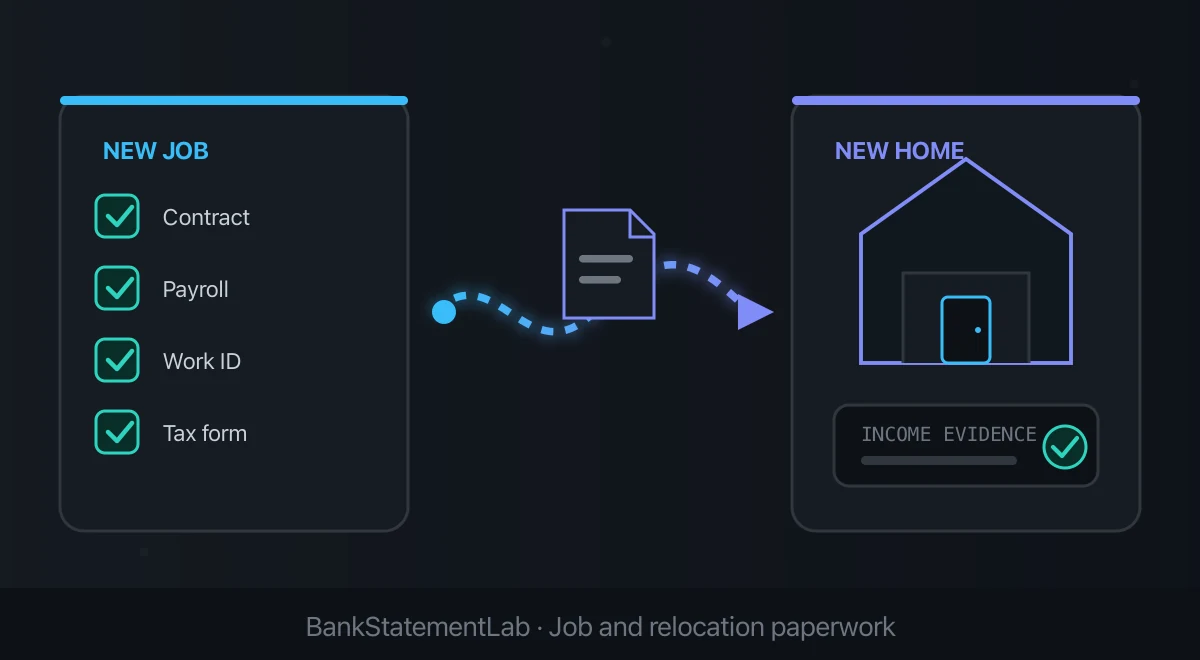
For a new job or a move, prepare four groups of documents: identity and right-to-work evidence, your signed offer or contract, proof of income (payslips, an employer letter and the bank statements a landlord asks for), and proof of your new address. Keep untouched originals, ask each recipient for its written list, and send only what it requests.
Accepting an offer can trigger three paperwork processes at once: starting the job, proving that you can afford a new home, and establishing yourself in a new city or country. The same document may help with more than one process, but the required version, age and level of detail can differ.
This guide organizes the financial documents for a new job or relocation into one practical system. It covers employment contracts, payslips, bank statements, tax records, proof of address and rental evidence—without assuming that one country’s checklist applies everywhere. Before sending anything sensitive, ask the employer, landlord, bank or authority for its current written requirements.
Before the paperwork begins, make sure the application itself is ready. If you are still applying or adapting your CV for a new market, FutuRole’s Free ATS Resume Scanner can help you check whether an applicant tracking system is likely to read its structure and content correctly.
Quick checklist: which document is used for what?
| Document | What it can help establish | Who may request it |
|---|---|---|
| Passport or accepted identity document | Identity and, in some processes, nationality | Employer, immigration authority, landlord, bank |
| Right-to-work evidence | Eligibility to work | Employer or immigration authority |
| Visa, residence or right-to-rent evidence | Immigration status or eligibility to rent, where required | Immigration authority or landlord under local rules |
| Signed offer letter or employment contract | Employer, role, start date and agreed pay | Employer, landlord, bank, immigration authority |
| Recent payslips | Gross pay, deductions and net pay | Landlord, lender, bank, public authority |
| Employer or salary verification letter | Current employment and compensation | Landlord, lender, immigration authority |
| Bank statements | Deposits, available funds and sometimes address | Landlord, lender, visa authority, bank |
| Tax returns or tax certificates | Historical declared income | Landlord, lender, tax or immigration authority |
| Tenancy agreement, utility bill or government letter | Current residential address | Employer, bank, insurer, public authority |
| Qualifications or professional licenses | Eligibility for a regulated or specialist role | Employer, professional regulator, immigration authority |
This is a preparation list, not an instruction to send every file. Start with the recipient’s checklist and provide the smallest complete set that satisfies it.
The bank-issued PDF is what you submit. For your own preparation, such as totaling three months of salary deposits before a lease application or listing the direct debits to move, a bank statement converter for your own checks turns the transaction table into rows you can sort. To convert a bank statement PDF to Excel with dates, descriptions and amounts in separate columns, a new account includes 5 credits (1 credit = 1 page).
Documents you may need to start a new job
Identity and right-to-work evidence
You may be asked for a passport or national identity document and, where applicable, separate evidence that you are authorized to work. The accepted combination depends on the country, your nationality and your immigration status.
For U.S. Form I-9, you generally choose acceptable documentation from List A or one document each from Lists B and C. Your employer cannot specify which acceptable documents you present for this check. USCIS list of acceptable documents · Form I-9 instructions
Check expiry dates early. If an original, online status check or certified copy is required, allow enough time to obtain it without emailing sensitive identity files to an unverified address.
Offer letter and employment contract
Save both the offer you accepted and the final signed contract. The useful fields usually include:
- the employer’s legal name and contact details;
- your role, work location and start date;
- salary, currency and payment frequency;
- working hours and contract duration;
- probation, benefits, leave and relocation terms;
- any conditions that still need to be satisfied.
An offer can be conditional, so do not present it as unconditional proof if references, immigration approval or another check remains outstanding. As one official example, the UK guidance on job offers distinguishes conditional and unconditional offers, while its written-employment-particulars guidance shows the kinds of terms a worker should be able to verify.
If the employer is funding the move, keep the relocation policy too. It may explain reimbursable costs, repayment clauses, temporary housing, tax support and the deadline for submitting receipts.
Moving costs: what the US and UK tax rules mean for your receipts
Keep every moving receipt, but do not assume it creates a tax deduction. In the US, IRS guidance limits the moving-expense deduction to active-duty members of the Armed Forces on a qualifying move and, for moves in 2026 or later, certain intelligence community employees and new appointees. For other employees, the IRS 2026 employer guide says the exclusion for qualified moving expense reimbursements has been permanently eliminated, so ask payroll how a relocation payment will appear on your pay. IRS Tax Topic 455 · IRS Publication 15-B
In the UK, the rules focus on what your employer pays. HMRC guidance says some qualifying relocation costs up to £8,000 are exempt from tax and National Insurance when you move to a new area to start a new job (or change workplace with the same employer), and the costs are paid before the end of the tax year after the one in which you started. Amounts above that limit may be reported and taxed. GOV.UK: relocation expenses, what’s exempt
Your employer’s relocation team will usually want invoices and proof of payment. A card or bank statement is useful as proof of payment next to the invoice, not instead of it.
Payroll, tax and bank details
HR or payroll may need a local tax or social-insurance identifier, a withholding form, and bank details for salary payments. Provide only the account information requested for payroll. A legitimate employer does not need your online-banking password, PIN or one-time authentication code.
In the U.S., Form W-4 tells payroll how much federal income tax to withhold. In the UK, HMRC provides a starter checklist for employees starting a job without a P45. IRS Form W-4 · HMRC starter checklist
When the first payslip arrives, check your name, pay period, gross pay, deductions and net amount. A payslip can later support a rental or banking application, but it is also your earliest chance to catch an incorrect salary, tax code or deduction. The GOV.UK payslip guidance is one country-specific example of the information a payslip can evidence.
Qualifications, licenses and benefits records
A regulated profession may require a license, diploma, certified translation or recognition decision before you can work. Ask whether the employer needs the original, a scan, a certified copy or direct verification from the issuing body.
Also retain benefit-enrollment confirmations, pension choices, insurance documents and beneficiary selections. These are not usually proof of income, but they can affect payroll deductions and become difficult to reconstruct after a move.
Documents that can prove your income
No single document answers every income question. A useful package connects what you are contractually entitled to earn, what has been paid, and what has been declared where required.
Recent payslips
Payslips are often the simplest evidence for an employee because they show a defined pay period, gross pay, deductions and net pay. Use complete employer-issued documents, not cropped screenshots. If a bonus, commission or allowance varies, the recipient may ask for several periods or separate confirmation.
Employment or salary verification letter
An employer letter can confirm your job title, status, start date and salary. It is especially useful when you are relocating before your first payday. Ask the recipient whether it requires a named HR contact, recent date, signature or company letterhead.
Signed offer or contract before the first payslip
A landlord may accept an offer or contract when the job has not yet started, but that is a policy decision—not a universal right. Clarify whether a conditional offer is acceptable and whether the stated salary meets the property’s affordability criteria.
Tax records
A filed return, assessment or official tax transcript can provide historical context, especially for variable or self-employed income. It may contain more sensitive information than the recipient needs, so confirm the exact form and tax year before sharing it.
Bank statements
A bank statement can show salary deposits, available funds and account ownership. It cannot by itself prove that every credit is employment income, that future pay will continue or that a transfer between your own accounts is new income.
If a bank statement is requested:
- Download the official PDF directly from the bank.
- Confirm the account and exact date range required.
- Include every required page and keep the original untouched.
- Reconcile salary deposits to the relevant payslips or contract.
- Ask before redacting transactions or account details.
If you are self-employed, ask which income documents the landlord accepts and which period they must cover.
Showing income when you move to another state or city
When you move for a job, your income evidence usually comes from two places: the old job (recent payslips and the salary deposits on your current bank statements) and the new one (the signed offer or an employer letter with start date and salary). Present them together so the landlord sees continuity rather than a gap. If you keep your existing bank account after the move, its statements remain valid evidence; the address printed on them may simply be the old one, so do not rely on them as proof of your new address.
Evidence for freelancers and contractors
Freelancers may need a combination of contracts, invoices, tax returns, an accountant’s letter, a profit-and-loss statement and business or personal bank statements. Keep gross billings, fees, transfers and net deposits distinct; a payment processor’s net deposit does not show the full invoice value on its own.
Financial documents for renting after relocation
The awkward timing is common: the apartment application arrives before your first payslip. Build a coherent file that explains the transition instead of submitting unrelated documents in bulk.
A practical rental pack
For example, if your rental application is due before your first payday, ask whether the landlord accepts a signed offer or an employer letter showing your start date and salary. Send payroll details to your employer through its payroll channel. Include a bank statement in the rental pack only if the landlord requests it.
- Identity and any locally required right-to-rent evidence
- Signed offer, contract or employer confirmation showing start date and pay
- Recent payslips from your previous or current employer, if relevant
- Requested bank statements showing funds or deposits
- Tax or self-employment records if ordinary payslips do not reflect your income
- Previous-landlord reference or rental history, where used locally
- Guarantor documents or proof of savings, if the landlord accepts them
Rental screening rules differ widely. In England, for example, official right-to-rent guidance describes specific identity and immigration-status checks; it should not be generalized to another country. In the United States, the Consumer Financial Protection Bureau advises applicants to review rental background-check information and dispute errors that may affect the decision or rental terms.
Before sharing financial files, ask four questions:
- Which documents and how many months are required?
- Are downloaded PDFs accepted, or are originals or verified copies needed?
- May irrelevant transactions or part of the account number be redacted?
- How will the files be transferred, retained and deleted?
Extra documents when moving to another country
An employment contract does not automatically give you the right to live or work in the destination country. Check the official immigration portal before traveling and separate four issues that are often confused: entry permission, residence status, work authorization and local registration.
Visa, residence and proof-of-funds documents
Depending on the route, you may need a passport, visa, work permit, employer sponsorship evidence, civil-status records, proof of accommodation, health-insurance evidence or proof of funds. Requirements can change by nationality, family situation and length of stay.
For EU citizens moving within the EU, the official Your Europe residence guidance explains that registration requirements and supporting documents depend on status and destination. Non-EU applicants should use the destination country’s official immigration source.
For a short-stay Schengen visa, start with the European Commission’s guidance. Check the consulate of your main destination for the documents it accepts as evidence of financial means. European Commission guidance on applying for a Schengen visa
Tax and social-insurance records
Keep recent payslips, annual earnings statements, tax returns, tax-residency documents, pension or social-insurance records and evidence of taxes already paid. These may help an adviser or authority determine where income should be reported and whether a treaty applies.
Do not reduce cross-border tax residence to a single “183-day rule.” Time spent in a country is only one factor; domestic rules, your home and personal ties, place of work and an applicable tax treaty may all matter. The EU’s income-taxes-abroad overview illustrates why two countries’ rules may need to be checked.
Translations, certified copies and apostilles
Ask the receiving authority which documents require translation, who may translate them and whether certification, legalization or an apostille is necessary. Some public documents moving between EU countries can benefit from simplified rules, as explained by Your Europe, but those rules do not apply to every document or destination.
Verify the requirement before paying for a translation or apostille. A polished but unnecessary version wastes money; the wrong type of certification can still be rejected.
Proof of address when you have just moved
Proof of address is a moving target during relocation: your old bank statement may be official but shows the former address, while the new utility account may not have produced its first bill.
Commonly requested options include:
- a signed tenancy agreement;
- a utility bill or local tax notice;
- a bank statement showing the new address;
- a government, insurer or employer letter;
- a residence-registration certificate.
Acceptance and recency limits are process-specific. Ask whether an electronic PDF is valid and whether two documents are required. Do not change an address inside an existing statement; update it through the bank and wait for a newly issued record if that is what the process requires.
Proof of relocation for an employer
An employer that reimburses a move may ask for “proof of relocation” rather than proof of address. In practice that is a set of records showing the move took place: the new lease or purchase completion, the moving company’s invoice, travel receipts and the payment records behind them. Check the relocation policy for the exact list and deadline.
Tell the tax authority your new address
- In the US, Form 8822 is used to notify the IRS of a change to your home mailing address. IRS: About Form 8822
- In the UK, you update your address for Income Tax, National Insurance, Child Benefit and State Pension through your HMRC personal tax account, and only once you have moved. GOV.UK: tell HMRC about a change of address
Reconcile your accounts before you move
A short reconciliation before the move catches problems while you still have access to the old address, the old employer’s payroll team and every account login. It also produces the figures a landlord or relocation team may ask about.
- Download the statements for the period each recipient requested (for your own check, the last two or three months is a practical window) for every account you will use as evidence, as bank-issued PDFs.
- Match each salary deposit to its payslip. The net pay on the payslip should equal the deposit; a difference points to a missing payslip, a bonus or a split payment.
- List recurring payments to move, cancel or redirect: rent, utilities, phone, insurance, subscriptions and any direct debits tied to the old address.
- Note the closing balance of each account on the statement date, and check that internal transfers between your own accounts are not counted twice as income.
- Keep the reconciliation as a working file, separate from the documents you submit.
A sorted table makes steps 2 to 4 faster than scrolling PDF pages. Sample data, fictional:
| Date | Description | Amount | Category note |
|---|---|---|---|
| 2026-09-30 | ACME CORP PAYROLL | 3,412.18 | Salary, matches September payslip |
| 2026-10-01 | CITY POWER AUTOPAY | -84.20 | Utility, close at old address |
| 2026-10-03 | TRANSFER TO SAVINGS | -500.00 | Internal transfer, not income |
| 2026-10-15 | STREAMING SUBSCRIPTION | -15.99 | Recurring, keep |
| 2026-10-31 | ACME CORP PAYROLL | 3,412.18 | Salary, matches October payslip |
BankStatementLab exports the transaction table to Excel or CSV with date, description and amount columns (debit and credit, and balance when the statement prints them); the category notes above are yours to add. Before you choose a plan, you can preview the first two pages of one statement without an account. Check the result against every PDF page, and submit the bank-issued statement unless the recipient asks for a spreadsheet.
How to organize and share the documents safely
Keep a source folder and a submission folder
Keep untouched originals in a read-only source folder. Create a separate submission folder containing only the files requested for one recipient. This prevents an edited working copy from being mistaken for the original and reduces accidental oversharing.
Use clear filenames such as 2026-07_Payslip_Employer.pdf or 2026-05_to_2026-07_Bank_Statement.pdf. Add a checklist with the recipient, date sent, approved redactions and retention deadline—but never store account passwords in it.
Retention rules depend on why the document exists and which jurisdiction applies. Use our bank-statement retention guide to separate tax, rental, immigration and dispute records instead of assigning one arbitrary deletion date to everything.
Prefer official PDFs to screenshots
Screenshots can omit page numbers, statement periods and issuer information. Download the institution-issued PDF or request the prescribed format. Never edit a date, balance, name, transaction or employer detail to make a file look more suitable.
Share the minimum complete evidence
Data minimization does not mean making a document unverifiable. Ask what can be redacted, preserve the meaning of the evidence and keep a complete original. Confirm the recipient through an official channel, use its authenticated portal where available and enable multi-factor authentication on the accounts that store the files.
If the recipient allows redaction, use a redaction tool that permanently removes the agreed information from the copy, including hidden text and metadata that contain it. Reopen the saved PDF and check for recoverable text and hidden information. Make sure the required evidence is still visible. ICO guidance on securely disclosing documents
Our guide to uploading bank statements safely explains what to check before sending a sensitive PDF to any online service.
If the approved transfer method is email or another file channel, consider whether you should password-protect the PDF without uploading it, then send the password through a separate verified channel. Confirm first that the recipient can open the protected format.
Use structured data only as a working copy
When several statements must be reconciled, searching a spreadsheet can be easier than reviewing pages of PDFs. BankStatementLab can extract bank-statement rows into Excel, CSV or OFX for your own checks. If the PDF asks for a password when it opens, use the password you already know to remove it locally from an authorized copy. Compare every extracted table with every source page, checking amounts, signs, dates and missing or duplicate rows. Check the full result even when the first table and the balance look correct. Submit the bank-issued statement unless the recipient explicitly requests structured data.
Source files are never stored on our servers. Keep your own original.
Prepare a structured working copy with BankStatementLab →
Final checklist before you start the job or move
- Ask each recipient for its current written document list.
- Check identity, visa, permit and license expiry dates.
- Save the accepted offer, signed contract and relocation policy.
- Download recent payslips, bank statements and relevant tax records.
- Confirm what will be accepted before your first payslip exists.
- Obtain proof of the new address in an accepted format.
- Match recent salary deposits to payslips and list the recurring payments to move.
- Keep moving invoices and payment records for your employer’s relocation policy.
- Update your address with the IRS or HMRC once you have moved.
- Verify translation, certification and apostille requirements.
- Keep untouched originals separate from submission copies.
- Use a secure, verified transfer channel.
- Record what you sent and when it should be deleted or reviewed.
Frequently Asked Questions
What documents do I need when starting a new job?
The exact list is local and employer-specific. Common requests include accepted identity and work-authorization evidence, a signed offer or contract, tax or social-insurance details, bank details for payroll, and any required qualifications or licenses. Ask HR for the official checklist before your first day.
Can a bank statement be used as proof of income?
Sometimes. A landlord or authority may accept a bank statement alone or alongside payslips, a tax return, an employment letter or a contract. Ask which accounts, period and format they require; a statement does not automatically replace every other income document.
What if I have not received my first payslip yet?
A signed contract, unconditional offer or recent employer confirmation may help establish your start date and salary before the first payday. Acceptance is not universal, so ask the landlord, bank or authority which alternative evidence it accepts.
How many months of bank statements should I prepare?
There is no universal period. The recipient may request one statement, several recent months or a different form of evidence. Confirm the precise date range before downloading files so you do not disclose more financial history than necessary.
What can I use as proof of address after moving?
Common examples include a tenancy agreement, utility bill, bank statement or government letter. Accepted documents, recency limits and digital-copy rules differ, and a document showing your former address may not establish your new one.
Should I redact my bank statement before sharing it?
Ask the recipient first. Share only what the process requires, but do not remove information needed to authenticate the statement and never alter dates, balances or transactions. Keep an untouched bank-issued copy separate from any permitted redacted copy.
Do financial documents need a certified translation or apostille?
Possibly, especially for cross-border immigration or civil-document procedures. Requirements depend on the receiving authority and document type. Check its official instructions before paying for a translation, certification, legalization or apostille.
Can I deduct moving expenses for a new job?
In the US, most employees cannot. IRS guidance limits the deduction to active-duty Armed Forces members on a qualifying move and, for moves in 2026 or later, certain intelligence community employees. In the UK, the question is usually what your employer pays: HMRC exempts qualifying relocation costs up to £8,000. Keep receipts either way.
A document pack that tells one consistent story
The strongest relocation file is not the largest one. It is a small, current and internally consistent set of documents: the contract establishes what should happen, payslips and statements show what has happened, and tax or immigration records supply the formal context.
Start with the official checklist, preserve originals, explain genuine gaps and share only through a verified channel. That approach makes onboarding, renting and relocation easier while protecting the financial information inside the files.