Save hours every week
Turn your bank statements (PDF) into Excel, CSV or OFX, without manual retyping.
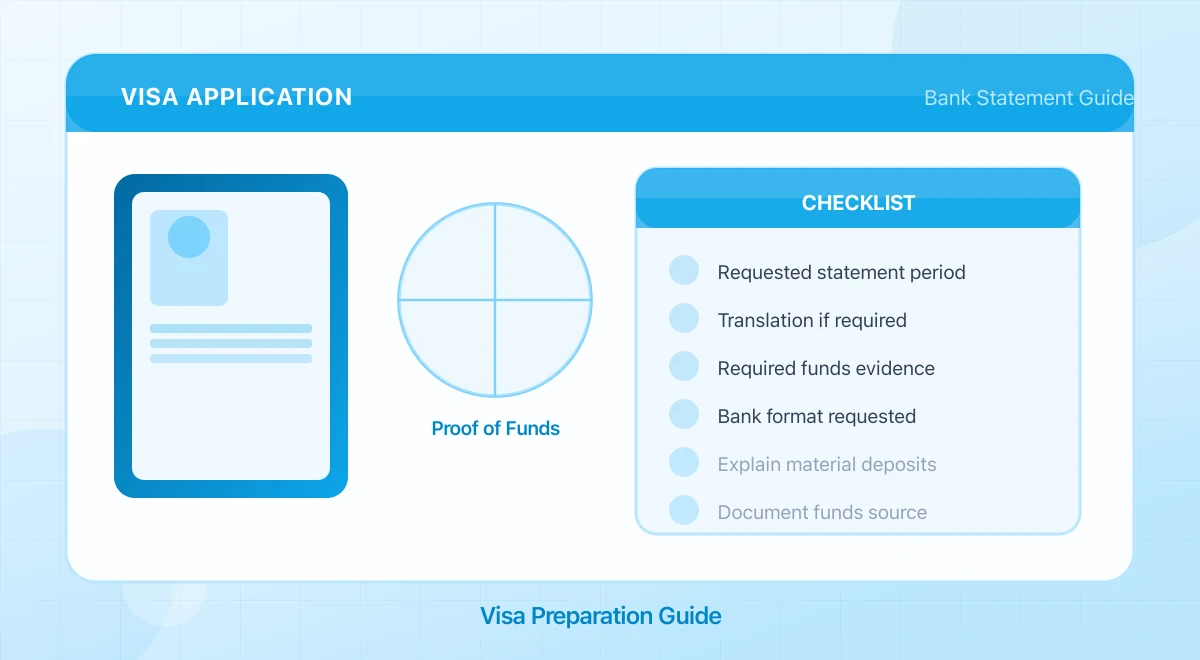
A bank statement for a visa application has no universal format, balance or history period. The destination, visa category, applicant country and local visa-office instructions control. Start with the official checklist, then use this guide to verify ownership, period, source of funds and consistency with your itinerary or study plan. A polished statement cannot replace missing eligibility evidence or guarantee a decision.

What Consulates Actually Check on Your Bank Statements
Where statements are requested, officers use them for the purposes set by the relevant immigration rules. That may include ability to pay, ownership, source or required holding period; ties and intention to leave are assessed with other evidence.
Your Identity and Account Ownership
The document should identify the account holder and financial institution as the official checklist requires. Explain material name differences. A stamp, seal, full account number or address is required only where the relevant instructions say so.
Consistent Income and Regular Deposits
If you rely on earnings, reconcile deposits with employment, tax or business evidence. Irregular income is not inherently invalid, but it may need clearer documentation.
Account Balance and Daily Spending Power
Different countries set different financial thresholds. While some publish explicit per-day minimums, others leave it to the visa officer’s judgment. Apply the financial test for the specific route: it may cover travel costs, tuition, maintenance or commitments at home. Do not substitute an invented buffer for the published calculation.
Transaction History and Spending Patterns
Transaction history can help show how funds accumulated and whether recent deposits have a documented source. There is no requirement to manufacture particular personal spending.
Suspicious Deposits and Fund Parking
A recent large deposit may require evidence of its source and availability. Salary bonuses, asset sales, gifts or approved educational loans can be legitimate where the route accepts them. Follow any required holding period, and never present temporarily borrowed money as unrestricted savings.
Duration of Statement History
Provide the exact period named in the official instructions. For example, Canada’s current visitor-visa page asks for at least six months of account details, while its study-permit page now lists the past six months of statements, including the application month or preceding month, among possible evidence; other countries and posts differ.
Bank Statement Requirements by Visa Type
Financial expectations vary significantly depending on the type of visa you are applying for. The table below outlines the key differences.
| Requirement | Tourist Visa | Student Visa | Work Visa |
|---|---|---|---|
| Statement period | Destination/post-specific | Program-specific | Program-specific |
| What funds cover | Trip costs as defined by the visitor rules | Tuition, living and travel amounts defined by the program | Any financial requirement named by the route |
| Additional documents | Itinerary, accommodation or ties as requested | Acceptance and tuition evidence as requested | Employment and sponsor documents as requested |
| Third-party support | Only under the route’s rules | Often possible with prescribed evidence | Route-specific |
Country-Specific Financial Thresholds
Do not use unofficial “recommended balances.” The official approaches differ:
- Schengen short stay: member states publish different reference amounts; use the competent post’s document list and the Commission table.
- United Kingdom visitor: Home Office guidance assesses trip costs, income or savings and ongoing commitments; it does not publish one universal visitor balance.
- United States visitor: the Department of State may request evidence of ability to pay, and tells applicants to follow the embassy or consulate’s instructions.
- Canada visitor: IRCC currently describes the account information it wants and notes that funds depend on the stay.
How to Prepare Your Bank Statements Step by Step
Follow these steps to prepare the evidence requested for your route.
Step 1: Check the Specific Requirements
Before you do anything else, visit the official website of the consulate or embassy where you are applying. Look for their specific documentation checklist. Pay close attention to how many months of statements they require, whether they accept digital statements or need originals, and if they require a bank stamp or certification.
Step 2: Request Official Statements
Contact your bank and request official statements for the required period. Ask for stamped or certified copies if the consulate requires them. Many banks offer this service at the branch, and some charge a small fee. If the consulate accepts digital statements, download them directly from your online banking portal and ensure they display your full name, account number, and the bank’s branding.
Step 3: Review Your Transaction History
Before submitting, review ownership, period and completeness. Keep source evidence for material recent transfers, a tax repayment, asset-sale proceeds or other non-routine deposits.
Step 4: Ensure Sufficient Balance
Calculate the requirement using the official rule for the visa category and actual itinerary or study period. Include only additional assets the checklist accepts; an unofficial percentage buffer does not guarantee a decision.
Step 5: Organize Supporting Financial Documents
Provide the supporting documents named in the checklist, such as employment, tax, sponsor, tuition or accommodation evidence. More unrelated documents are not automatically stronger.
Step 6: Format and Present Clearly
Make sure your statements are legible, complete (no missing pages), and organized chronologically. If your statements are in a language other than the one required by the consulate, you may need to provide certified translations.
For your own review, a spreadsheet can help trace deposits and calculate totals. Submit the original bank-issued document and certified translation when required; do not replace it with a recreated spreadsheet.
Need an internal review sheet? BankStatementLab extracts statement PDFs into Excel, CSV or JSON. Unlock password-protected files before upload and compare all extracted tables with every original page. A matching balance alone does not prove completeness. The export is not an official consular document. Try it →
Five statement problems to check
These issues can make financial evidence incomplete or cause follow-up. The authority decides the application as a whole.
1. Last-Minute Large Deposits
A recent material deposit may need a source explanation. Do not temporarily borrow or move funds to misrepresent availability. For legitimate transfers, retain both sides and the underlying document.
2. Insufficient Statement Period
Submit the exact period requested. Do not assume an extra month cures a missing page or wrong date range.
3. Missing Bank Authentication
Some posts require a stamp, signature or bank letter; others accept portal PDFs. Follow the local instructions rather than a universal rule.
4. Unexplained Transactions
Large withdrawals, transfers to unknown accounts, or irregular deposits without context can raise suspicion. If your statements contain any unusual activity, prepare a brief written explanation and attach supporting documents such as invoices, contracts, or receipts.
5. Account Balance Below the Threshold
The available funds must satisfy the route-specific test when one applies. Calculate the correct duration and covered costs; avoid unofficial recommended balances.
Use this checklist to identify gaps before submission.
| Issue | Why Evidence May Be Incomplete | How to Address It |
|---|---|---|
| Recent material deposits | Source or availability may be unclear | Provide lawful source evidence |
| Insufficient statement period | Requested evidence is incomplete | Provide the exact period and every page |
| Wrong authentication format | Does not meet the local checklist | Obtain the specified bank document |
| Unexplained large transactions | Source, purpose or availability is unclear | Provide source documentation for unusual transfers |
| Funds do not meet the official test | Required costs are not demonstrated | Recalculate using the current official rule |
Special Cases: Sponsors, Self-Employed Applicants, and Students
Not everyone fits neatly into the standard bank statement scenario. Here is how to handle the most common special situations.
When Someone Else Is Sponsoring Your Trip
Third-party support is allowed only under the route’s rules. Follow the checklist for the sponsor’s undertaking, finances, status and relationship evidence rather than assuming one package works worldwide.
A sponsor may have distinct evidence requirements. Verify that the promised support is documented, available and accepted for the route, including any required undertaking.
If You Are Self-Employed
Self-employed applicants should use the documents accepted by the route—potentially business and personal statements, tax records, financial statements, contracts or an accountant’s letter. Explain seasonal income; do not add a full year unless requested or clearly relevant. For record organization, see our guide to preparing bank statements for an accountant.
If You Are a Student
Student routes may accept parental support, scholarships, savings or qualifying education loans, with different conditions. Use the route’s list to establish the amount, account ownership, holding period and evidence for each source. Supply parental records, scholarship letters or tuition receipts where required; a generic sponsorship letter does not replace prescribed evidence.
If You Have Multiple Bank Accounts
Use multiple accounts only if the checklist permits them and they are needed to demonstrate the funds. Explain transfers so the same balance is not counted twice.
Tips for a Stress-Free Bank Statement Preparation
Preparing your bank statement for a visa application does not have to be a last-minute scramble. Here are practical tips to make the process smoother.
- Start with the official checklist. Allow enough time to obtain bank letters, statements and translations.
- Use genuine records. Do not manufacture activity or temporarily move money to create an appearance.
- Avoid unnecessary large transfers. Moving money between accounts close to your application date can create confusion. If you must transfer funds, keep records of the reason and source.
- Save source documents. Retain evidence for a large payment, bonus, tax repayment, gift or asset sale.
- Do not make account decisions for optics. Close or retain accounts for legitimate reasons and disclose relevant changes.
- Present everything legibly. Clear labels help the reviewer locate the requested evidence. Label your documents, use dividers if submitting a physical file, and make sure every page is legible.
Conclusion
Financial evidence should answer the test for the specific destination and visa category. Verify the official amount or cost calculation, required history, accepted account type and sponsor rules, then submit complete source documents with factual explanations.
If a long PDF is hard to review, use a structured copy to check calculations and transfers while preserving the original evidence.
Ready to review your statement data? BankStatementLab converts PDF statements into Excel, CSV or JSON for internal checks. Submit the official bank evidence required by the authority. Get started →
Save hours every week
Turn your bank statements (PDF) into Excel, CSV or OFX, without manual retyping.