Save hours every week
Turn your bank statements (PDF) into Excel, CSV or OFX, without manual retyping.
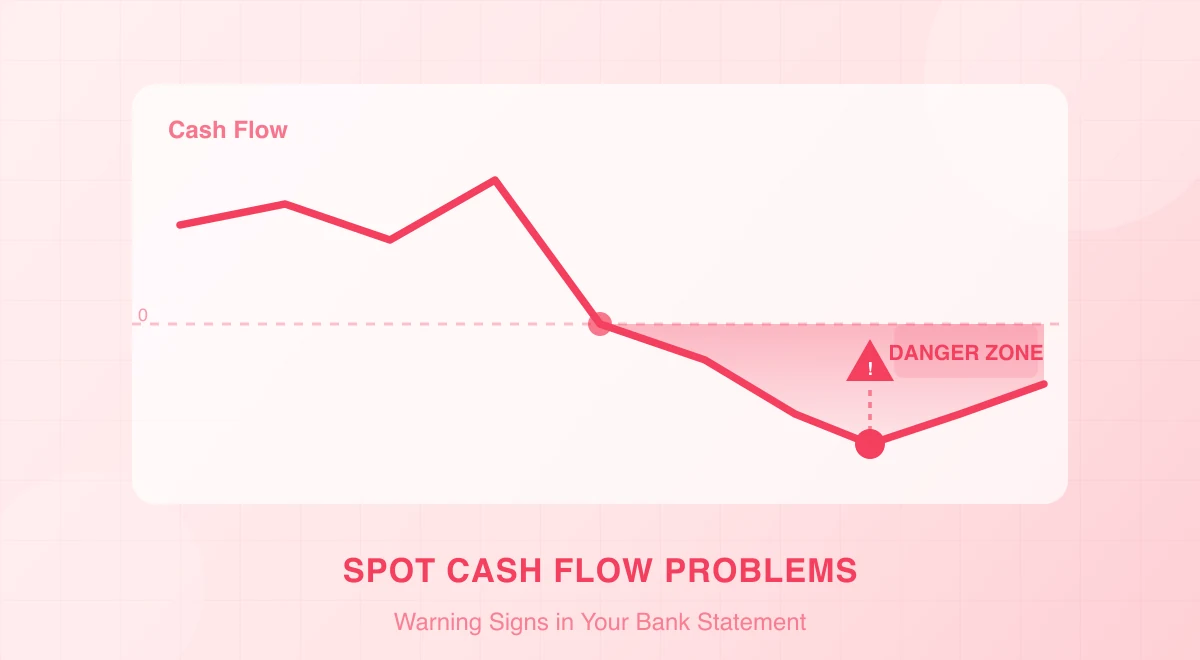
A bank statement can reveal that cash pressure is developing, but it cannot predict the next shortfall by itself. It records posted cash, while invoices, unpaid bills, payroll commitments, inventory needs, and tax deadlines may sit elsewhere.
Use statement patterns as diagnostic alerts. Compare them with your cash forecast and operating records, then investigate the cause. There is no universal balance, ratio, or number of days that defines safety for every business.
Seven bank-statement warning signs
| Warning sign | Statement evidence | Records to check next |
|---|---|---|
| Operating outflows repeatedly exceed operating inflows | negative net operating cash by week or month | sales, margins, receivables, payables |
| The lowest balance is falling | less headroom before scheduled payments | short-term cash forecast |
| Deposits arrive later than fixed payments | wider timing gap | invoice aging and customer terms |
| Overdraft, returned-payment, or late charges recur | repeated fee descriptions | payment schedule and bank terms |
| Owner funds or borrowing support routine bills | injections followed by payroll, rent, or suppliers | financing plan and operating model |
| Seasonal recovery weakens | comparable peak or closing balances decline | year-over-year sales and cost data |
| Large obligations cluster without matching cash | recurring payroll, tax, debt, or rent pattern | due-date calendar and forecast |
None of these proves insolvency or identifies the cause. Each is a prompt for a documented review.
1. Operating cash stays negative
Separate operating receipts and payments from transfers, owner movements, loans, and asset purchases.
Net operating cash = operating inflows - operating outflows
A negative week may be expected because payroll or rent clusters on one date. The concern is a repeated or worsening pattern that your forecast did not anticipate.
Check whether the cause is:
- lower sales volume or price;
- slower customer collection;
- higher supplier, payroll, or occupancy costs;
- a one-off operating event;
- misclassification of financing or transfers.
Do not use total deposits as operating revenue. Loan proceeds and owner contributions can make the bank balance rise while core operations consume cash.
2. The balance floor is falling
Track the lowest recorded balance in each comparable period, not only the month-end balance. A posted statement balance is not necessarily the available balance: pending holds, uncleared deposits and facility limits may change what you can spend. Month-end can look comfortable even if the account nearly ran out earlier.
Use consistent observations such as weekly closing balances. If the bank statement supplies daily balances, preserve the bank’s own figures. If not, do not pretend that transaction rows produce a complete daily average without accounting for non-transaction days and value-date rules.
A falling floor means less room for delay or surprise. Whether it is dangerous depends on payroll, tax, debt, supplier commitments, overdraft terms, and access to committed funding.
3. Cash timing moves against you
Map major recurring inflows and outflows by posted date. This fictional example starts with 30,000 in cash and has no financing or other movements:
| Week | Operating inflows | Operating outflows | Net movement | Closing balance |
|---|---|---|---|---|
| 1 | 12,400 | 18,200 | (5,800) | 24,200 |
| 2 | 8,600 | 6,100 | 2,500 | 26,700 |
| 3 | 15,300 | 9,400 | 5,900 | 32,600 |
| 4 | 6,200 | 14,800 | (8,600) | 24,000 |
Total inflows are 42,500 and outflows are 48,500: net movement is −6,000, taking the opening 30,000 to 24,000. The positive weeks in the middle do not reverse the month’s overall cash decline. These weekly closing balances also do not reveal the lowest balance within each week.
For a separate timing example, a week may open with 5,000, pay 7,000 on Monday and receive 8,000 on Friday. It closes at 6,000, but Monday needs 2,000 of funding or an agreed payment reschedule. An acceptable closing balance does not establish that every payment could clear.
If deposits are shifting later, use invoice dates, due dates, and collection records to determine whether customer payment behavior changed. A statement only shows when cash posted, not when it was earned or due.
4. Exception fees and failed payments recur
Search descriptions for overdraft, insufficient-funds, returned-payment, late, and unarranged-borrowing terms used by your bank.
One fee can arise from an operational mistake. A recurring pattern can indicate that:
- scheduled payments are not aligned with collections;
- the forecast omits obligations;
- the account balance being monitored is not the available balance;
- payment approvals occur without a cash check;
- borrowing limits are being treated as permanent operating cash.
Confirm each fee against the bank notice and terms. Do not rely on description keywords alone.
5. Borrowing or owner injections mask operations
Label every non-operating inflow:
- owner contribution;
- transfer from reserves;
- line-of-credit draw;
- term-loan proceeds;
- asset sale;
- grants or other exceptional receipts, with classification based on their purpose and conditions.
Then produce two views: cash including financing, and operating cash excluding it. The warning is not the existence of funding; planned funding can be appropriate. The warning is repeated dependence that is absent from the plan or growing without a clear path to repayment or sustainable operations.
6. Seasonal recovery is weaker
Compare like with like: the same trading season, the same accounts, and the same classification policy. A lower bank peak can reflect deliberate investment, debt repayment, owner distributions, or tax timing—not only weaker trading.
Pair the bank comparison with:
- unit sales and prices;
- gross margin;
- aged receivables;
- inventory purchases;
- staffing;
- one-off capital spending.
The pattern becomes useful only when the bridge from operations to cash is explained.
7. Known obligations are not covered by the forecast
Statements reveal the cadence of past payroll, rent, taxes, debt service, and supplier runs. Copy those recurring cash dates into a forward-looking forecast and add known changes.
A statement cannot show an invoice that has not yet been paid or a tax amount not yet posted. The UK government business guidance explains that a cash-flow forecast should reflect when money is expected to enter and leave, include a running balance, and consider seasonality.
Compare the projected low point with:
- available cash;
- committed facilities and their conditions;
- payments that can genuinely be rescheduled;
- collections supported by customer commitments;
- a contingency for uncertain timing.
Use scenarios rather than one optimistic date. The Australian government’s cash-flow statement guide distinguishes actual movements from estimates used for a forecast. Keep the two clearly labeled in your workbook.
A controlled diagnostic workflow
1. Preserve and structure the data
Use the bank’s native export where available. If only a supported PDF or image exists, convert it to a spreadsheet and compare every period’s dates, amounts, signs, and balances with the original.
2. Classify cash by behavior
At minimum, separate:
- operating inflows;
- operating outflows;
- taxes;
- capital expenditure;
- debt principal and interest;
- owner movements;
- transfers;
- other financing;
- unknown items.
Unknown items stay visible. Transfers between owned accounts are matched and excluded from consolidated cash movement. Use the Excel categorization and PivotTable workflow to keep these classes separate before comparing periods.
3. Build comparable periods
Choose weekly or monthly periods appropriate to the payment cycle. Avoid changing categories between periods without restating prior data.
4. Flag changes, not arbitrary universal thresholds
For each signal, record:
| Signal | Current period | Prior comparable period | Forecast | Explanation | Owner |
|---|---|---|---|---|---|
| Lowest balance | |||||
| Operating net cash | |||||
| Financing inflows | |||||
| Exception fees |
Set internal triggers based on your payment calendar, risk appetite, lender terms, and professional advice.
5. Investigate and act
A useful alert ends with a decision:
- collect a specific overdue invoice;
- correct a billing or posting problem;
- revise purchasing or staffing timing;
- negotiate terms before the due date;
- stop or defer a discretionary commitment;
- update the forecast assumption;
- obtain professional restructuring or insolvency advice where appropriate.
Do not delay statutory payments or trade while insolvent based on a blog checklist. If the business cannot meet obligations as they fall due, seek qualified local advice promptly. The UK Insolvency Service explains why cash availability and timely customer payment matter.
What the statement cannot diagnose
A bank statement does not show:
- unpaid customer invoices;
- unpaid supplier bills;
- committed payroll changes;
- inventory demand;
- tax accruals;
- unused facility conditions;
- profitability by product or customer;
- future cancellations or orders.
This is why warning-sign analysis is distinct from a tracker. The cash-flow tracking guide builds an actual-versus-forecast table. This article helps decide which changes deserve investigation.
Monthly review checklist
- All operating accounts are included.
- Transfers and financing are separated from operations.
- Current periods use the same definitions as prior periods.
- Balance lows and payment timing are reviewed.
- Fees and failed payments have source explanations.
- Owner funding and borrowing are visible.
- Statement actuals update the forward forecast.
- Each material alert has an owner and action.
- A human reviewer challenges assumptions.
BankStatementLab can convert supported bank-statement PDFs and images to CSV, XLSX, or JSON when native transaction data is unavailable. Its output still requires validation and classification before any cash-flow conclusion.
Related articles
Convert supported statements into reviewable rows for your cash warning-sign check
Save hours every week
Turn your bank statements (PDF) into Excel, CSV or OFX, without manual retyping.